Powder Pressing Machine technology converts measured metal, ceramic, or pharmaceutical powder into a controlled compact. The process begins with die filling. A punch then applies pressure, often through mechanical, hydraulic, or servo-driven movement. The compact is ejected and may undergo sintering, drying, or further finishing. It sounds simple. It is not.
Grand View Research’s Powder Metallurgy Market Size, Share & Trends Analysis Report, 2024–2030, identifies growing demand for lightweight, material-efficient components in automotive, aerospace, and industrial applications. The Metal Powder Industries Federation also emphasizes dimensional control, tooling design, and repeatable density as essential production factors. These findings explain why modern presses use force sensors, position feedback, and programmable filling systems. A small variation in powder flow can create visible density differences across a 20-millimeter component.
A reliable Powder Pressing Machine must balance pressure, speed, powder behavior, and tool strength. Operators inspect die wear, lubrication, powder moisture, and ejection marks before accepting production results. ISO 3995, which covers powder metallurgy terminology and processes, provides a useful technical reference for consistent communication and quality planning. However, no machine eliminates every defect. Uneven particle size, trapped air, or poorly adjusted tooling can still produce cracks and lamination. That practical limitation deserves attention. Press selection should therefore consider product geometry, required tolerance, production volume, and material sensitivity, rather than headline force alone. The strongest machine is not always the most suitable one.
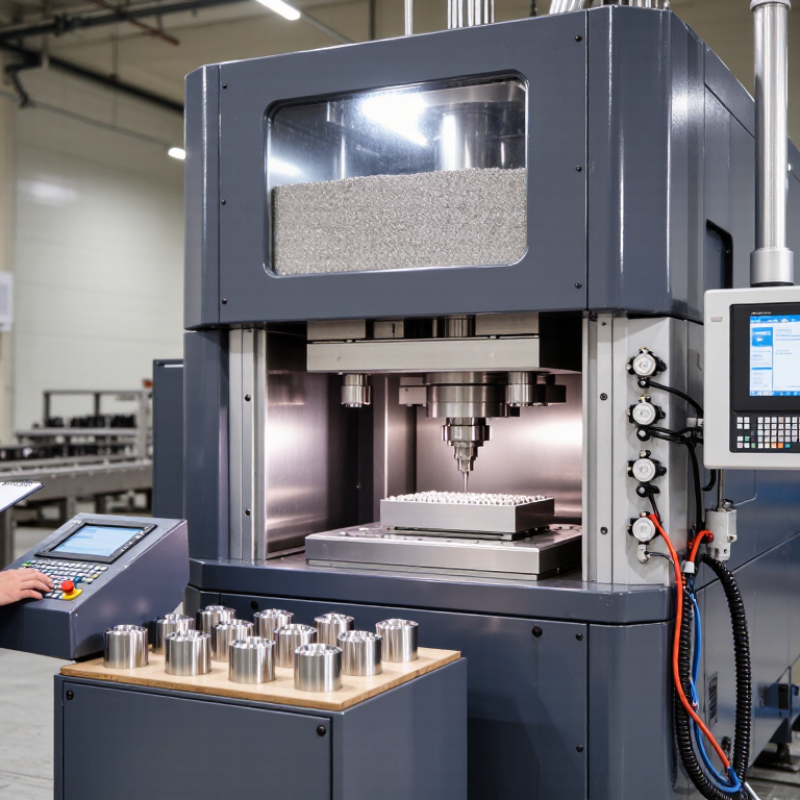
What Is a Powder Pressing Machine and How Does It Work?
A powder pressing machine is industrial equipment that shapes loose powder into a solid, controlled form. It applies pressure inside a specially designed die. The machine does not usually melt the material. Instead, it rearranges and compresses individual particles.
Its main function is consistent forming. A feeding system delivers a measured powder charge into the die cavity. The tooling then closes, and one or more punches apply force from above, below, or both directions. Pressure removes air pockets and improves particle contact. After compression, an ejection mechanism lifts the compact from the die.
Small details matter. Powder flow, moisture, particle size, and filling speed can affect the final shape. Operators often monitor pressing force, stroke position, cycle time, and ejection height. These readings help identify cracks, density variation, or sticking before production losses become serious. Some machines use mechanical drives, while others use hydraulic or servo-controlled systems. Each design offers different control, speed, and maintenance requirements.
The process is not foolproof. A compact may look smooth but still contain weak internal zones. Tool wear can also change dimensions gradually. For reliable results, technicians inspect sample parts, check powder distribution, and adjust pressure carefully. Excessive force is not always better; it may damage the tooling or create hidden defects. In practical production, stable settings usually matter more than maximum pressing force.
| Data Dimension | Definition or Component | Main Function | Typical Operating Information | Key Process Considerations |
|---|---|---|---|---|
| Machine Definition | Powder pressing machine | Forms loose powder into a compact part by applying controlled pressure inside a die. | Commonly uses a rigid die, one or more punches, a powder-filled cavity, and a pressure-control system. | The machine must maintain stable force, alignment, filling, and ejection conditions to produce consistent parts. |
| Primary Forming Method | Uniaxial powder compaction | Compresses powder mainly along one axis between opposing punches. | Suitable for relatively simple shapes with a consistent pressing direction. | Density may vary through the compact because pressure is transferred through the powder bed. |
| Powder Feed System | Feed shoe or filling mechanism | Delivers a measured quantity of powder into the die cavity. | Filling volume, feed movement, powder flow, and dwell time influence the final part weight. | Poor flowability or segregation can cause weight variation, voids, and uneven density. |
| Tooling | Die, upper punch, and lower punch | Defines the compact geometry and transfers force to the powder. | Tooling is selected according to part shape, dimensions, material, and required surface finish. | Clearance, wear, alignment, and lubrication affect dimensional accuracy and tool life. |
| Compaction Force | Applied pressing force | Reduces the volume of the powder bed and increases particle contact. | Often specified as force in kilonewtons (kN) or pressure in megapascals (MPa). | The correct force depends on powder composition, part size, geometry, and target green strength. |
| Compaction Sequence | Filling, compression, dwell, and release | Controls the transformation from loose powder to a shaped green compact. | A typical cycle includes die filling, punch movement, pressure holding, decompression, and ejection. | Controlled decompression helps reduce cracking, lamination, and elastic springback. |
| Green Compact | Pressed but unsintered part | Provides the required shape before subsequent thermal or finishing operations. | The compact has enough strength for handling but normally retains interconnected pores. | Green strength must be balanced with porosity, dimensional tolerances, and downstream processing needs. |
| Ejection System | Ejector movement or lower-punch withdrawal | Removes the compact from the die after pressing. | Ejection height and speed are set to release the part without damaging edges or surfaces. | High ejection force may indicate excessive friction, insufficient lubrication, or poor tooling alignment. |
| Drive Technology | Mechanical, hydraulic, or servo-controlled drive | Generates and regulates punch movement and pressing force. | Mechanical systems are suited to high-speed cycles; hydraulic and servo systems provide flexible force and motion control. | Selection depends on production rate, force profile, precision, energy use, and maintenance requirements. |
| Material Types | Metal, ceramic, carbide, graphite, and other engineered powders | Allows near-net-shape production of parts with controlled composition and porosity. | Powder characteristics include particle size, shape, moisture content, apparent density, and flowability. | Different materials require different compaction pressures, lubricants, binders, and post-pressing treatments. |
| Main Functions | Shaping, densification, sizing, and repeatable production | Produces parts with consistent geometry and controlled green density. | Suitable for bushings, gears, filters, wear components, structural parts, and other powder-based products. | Performance is evaluated through dimensional inspection, weight checks, density testing, and visual examination. |
| Quality Variables | Part weight, density, dimensions, hardness, and defects | Measures whether the compact meets specified production requirements. | Typical checks include weight variation, density distribution, cracks, chipping, lamination, and ejection marks. | Consistent powder preparation, tooling condition, force control, and machine calibration are essential. |
| Post-Pressing Operation | Sintering or other finishing process | Strengthens and stabilizes the pressed compact after ejection. | Sintering heats the compact below its melting point to promote bonding between particles. | Sintering can cause controlled shrinkage, so dimensional changes must be included in tool and process design. |
| Production Benefits | Material efficiency, repeatability, and reduced machining | Supports high-volume manufacturing of parts with consistent shapes and limited material waste. | Near-net-shape production can reduce cutting operations compared with machining from solid stock. | Economic benefits depend on tooling cost, production volume, powder price, cycle time, and quality requirements. |
| Safety Requirements | Machine guarding, interlocks, dust control, and operator procedures | Protects personnel from moving tooling, high forces, airborne powder, and unexpected machine motion. | Safety measures may include enclosed pressing areas, emergency stops, ventilation, and appropriate personal protective equipment. | Powder handling hazards vary by material; safety data and workplace regulations should guide the control measures. |