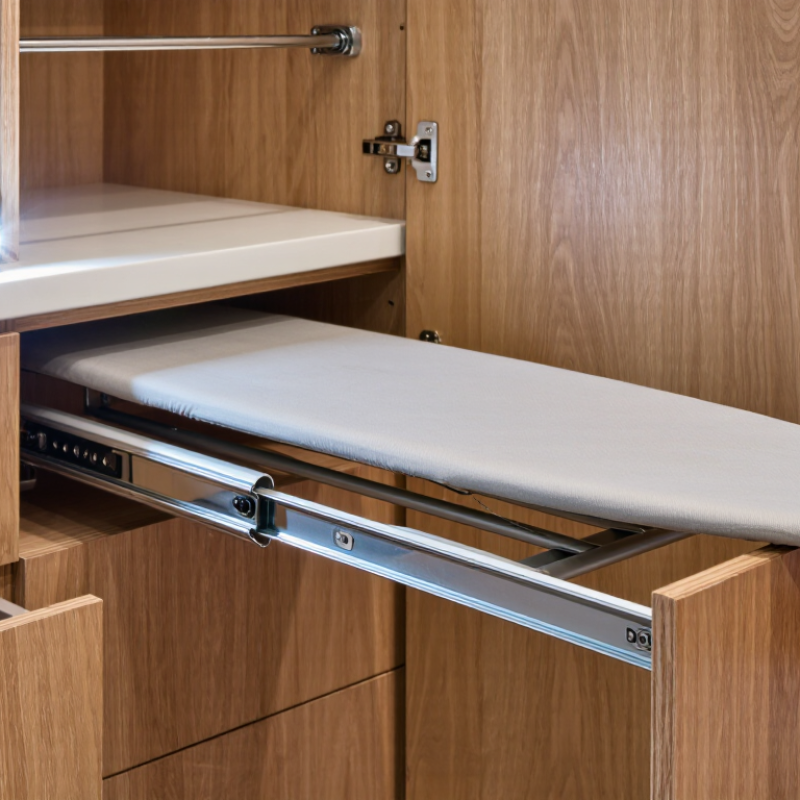
| Side-Mount Ball-Bearing Slide | Metal slide members are visible along both drawer sides. The slide usually has a disconnect lever or release tab. | About 12.7 mm (0.50 in) per side; confirm the slide specification before removing the drawer. | Approximately 34–45 kg (75–100 lb) per pair for common light- to medium-duty designs. | Usually available in 3/4-extension or full-extension versions; movement is generally smooth and controlled. | Often suitable when the drawer carries a folding board and light accessories, provided the rating covers the fully loaded drawer. | Open the drawer fully, support its weight, press or lift both release levers as required, and pull the drawer forward evenly. |
| Side-Mount Roller Slide | A plastic or metal roller is visible near the front or rear of each slide. The hardware is simpler than a ball-bearing slide. | Commonly about 12.7 mm (0.50 in) per side, but some systems require a different gap. | Approximately 23–34 kg (50–75 lb) per pair for common cabinet applications. | Typically 3/4 extension; it may feel less rigid at full opening than a ball-bearing slide. | Suitable for a lightweight ironing board drawer when the board and accessories remain within the stated rating. | Many versions require lifting the drawer front slightly while pulling forward; avoid forcing the rollers past the stops. |
| Bottom-Mount or Center-Mount Slide | Most of the hardware is hidden below the drawer or centered under it. The drawer sides may have little or no visible metal hardware. | Clearance varies substantially by design; use the installation instructions rather than assuming side clearance. | Approximately 11–23 kg (25–50 lb) per pair for common concealed or light-duty designs. | May provide partial or full extension; some versions include integrated stops or adjustment clips. | Appropriate only when the drawer construction and slide rating are designed for the board’s weight and pull-out leverage. | Look underneath for locking clips or release mechanisms. Support the drawer before disengaging the clips. |
| Soft-Close Slide | The drawer slows during the final closing section. A damper or closing mechanism is built into the slide or mounted beneath the drawer. | Depends on whether the mechanism is side-mounted or concealed; measure the installed hardware. | Commonly about 23–45 kg (50–100 lb) per pair, but the soft-close mechanism may have a lower practical limit. | Full extension is common; the final closing action is controlled by a damper and spring mechanism. | Useful when the drawer must close quietly, but the board should be pushed in gently rather than slammed. | Locate the release levers or underside clips. Do not pull against the damper after the slide has reached its stop. |
| Heavy-Duty Slide | Slides are thicker, wider, or reinforced and may use multiple ball-bearing rows or a substantial mounting channel. | Often greater than standard side-mount clearance; measure both sides and compare with the slide documentation. | Approximately 45–91 kg (100–200 lb) per pair for common heavy-duty categories. | Usually full extension with high rigidity; some designs include a hold-in or locking feature. | May be suitable for a heavier pull-out ironing system, but the cabinet, drawer box, fasteners, and mounting surface must have matching strength. | Release methods vary. Remove stored items, support the drawer, and verify that locking levers are fully disengaged before pulling it out. |
| Non-Disconnect or Captive Slide | The drawer reaches a stop but has no visible lever, tab, clip, or lift-out position for normal removal. | Use the installed slide’s measured clearance; do not pry the drawer sideways. | Use only the exact rating printed in the installation literature; generic estimates are not reliable for this type. | Travel is limited by captive stops, and the drawer may not be designed for routine removal. | Suitable for an ironing board drawer only if the complete assembly is designed for the board and its operating forces. | Check for concealed screws, stop tabs, or cabinet-side fasteners. Remove hardware only after the drawer is fully supported. |