What Is the Best Small Truck Crane Type in 2026?
Choosing the best small truck crane in 2026 requires more than comparing lifting capacity or purchase price. Real job sites are uneven, crowded, and rarely as predictable as brochures suggest. A compact crane may lift 2,000 kilograms on paper, yet lose practical value when its boom reaches sideways over a narrow street.
Mike Parnell, a respected crane-industry educator and lifting specialist, offers a useful warning: “Rated capacity is only meaningful when the lift plan reflects real site conditions.” That principle should guide every comparison in this article. A small truck crane must match the truck’s payload, axle limits, hydraulic system, stabilizer footprint, and daily work pattern. It should also provide clear controls, dependable overload protection, and accessible service points.
Small details matter.
For example, a crane working beside apartment buildings may need precise proportional controls more than maximum reach. A contractor delivering roof materials may value fast setup, while a municipal team may prefer low maintenance and strong corrosion protection. Electric or hybrid auxiliary systems could become more attractive in 2026, but their higher cost and charging requirements deserve careful review.
There is no perfect crane for every operator. That is easy to forget. The strongest model may be inefficient for light urban work. The cheapest model may create costly downtime later. This guide compares common small truck crane types through capacity, stability, reach, mobility, safety features, maintenance, and long-term operating value. Some conclusions may remain imperfect because local terrain, climate, and operator experience can change the result.
Small Truck Crane Types and Their Core Lifting Principles
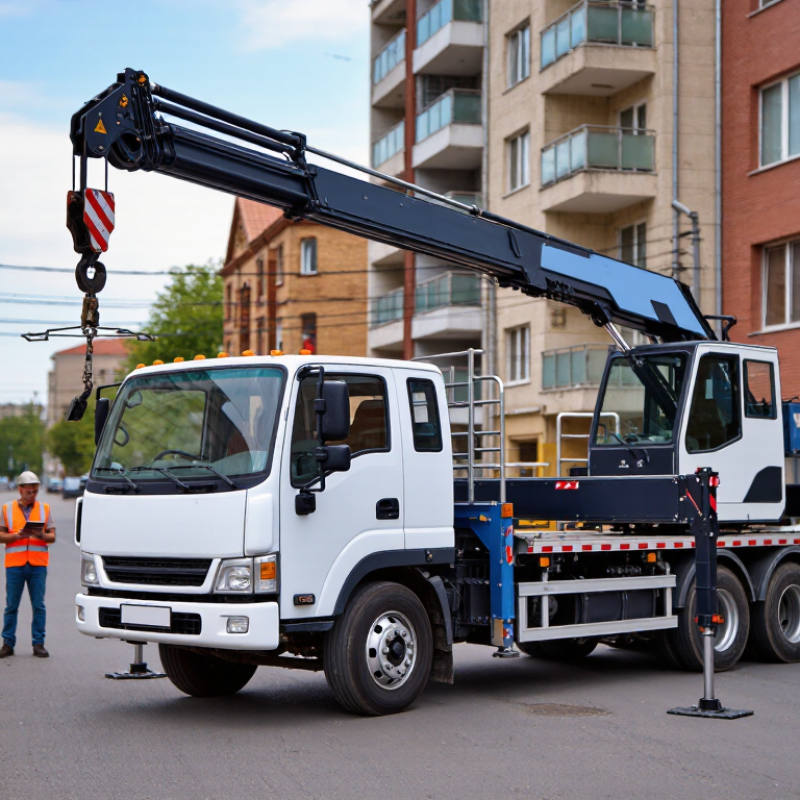
Choosing the best small truck crane in 2026 depends on the lifting principle, not only maximum capacity. A knuckle-boom crane folds beside the cab and uses articulated hydraulic joints. It suits deliveries in narrow streets and crowded construction sites. A telescopic boom extends in straight sections, giving better horizontal reach. However, extension reduces capacity quickly. A stiff-boom crane offers a simpler structure and steady lifting for repetitive loading. It usually needs more parking space.
The core principle is hydraulic force. Pump pressure moves the cylinders, while the boom geometry converts force into lifting torque. Load radius matters greatly. A 1,000-kilogram load close to the truck may become unsafe several meters away. The 2024 MarketsandMarkets truck-mounted crane report identifies construction, utilities, and logistics as major demand areas. Its forecast also indicates continued market growth through 2029. That growth may encourage smaller operators to select equipment too quickly.
Stability remains the practical limit. The truck’s center of gravity must stay inside its support footprint, with outriggers placed on firm ground. OSHA’s crane regulations require manufacturers’ load charts and proper ground assessment. In daily work, I would compare rated capacity, hydraulic control, outreach, and setup time. The “best” type is not always the strongest. Sometimes, a smaller knuckle boom performs better because it fits the site. Load charts can still feel optimistic when wind, slope, or uneven cargo enters the picture. That deserves careful review.
How to Match Crane Capacity with Small Truck Requirements
What Is the Best Small Truck Crane Type in 2026?
Matching crane capacity to a small truck starts with the lift, not the crane’s headline rating. A 500-kilogram load lifted three metres from the truck creates a nominal 1.5-tonne-metre load moment. That is only a screening calculation, not a safe working capacity. The actual load chart must account for boom angle, extension, lifting radius, and stabilizer setup. OSHA’s 29 CFR 1926.1417 requires operators to follow rated capacities and keep applicable load charts available. Check the chart at the farthest planned reach, where capacity can drop sharply.
Then check the truck. The crane, mounting frame, operator, tools, and cargo all consume payload. Their positions also affect front and rear axle loads. A compact service truck may have enough total payload on paper but still exceed an axle limit after installation. Weighing the completed vehicle is more reliable than relying on brochure figures. Honestly, this step is easy to overlook.
Tips: Write down the heaviest load, its distance from the truck, and the working height. Ask a qualified installer to verify the crane chart, chassis limits, and stabilizer footprint together. Leave a practical margin; real jobs rarely match a perfect diagram. A knuckle-boom crane may suit varied reach and storage needs, while a compact telescopic model may fit simpler lifts. The best type depends on the actual load chart and truck configuration.
What Is the Best Small Truck Crane Type in 2026? — How to Match Crane Capacity with Small Truck Requirements
The best small truck crane depends on the load, the working radius, the truck’s payload and axle limits, and the space available for setup. The capacity bands below are indicative planning categories, not standardized ratings; always verify the exact crane load chart and vehicle limits before lifting.
Small Truck Crane Types and Typical Applications
| Crane Type |
Indicative Rated-Moment Class |
Typical Applications |
Main Advantages |
Key Trade-Offs |
Best Match |
| Light-duty service-body crane |
Approximately 0.5–3 tonne-metres |
Tools, pumps, generators, small components, and routine service work. |
Compact installation; suitable for trucks that need to retain space for tools and equipment. |
Limited reach and lifting capability; the truck’s remaining payload can be reduced by the crane and its mounting equipment. |
Frequent light lifts from a service truck where compactness and access matter more than reach. |
| Compact knuckle-boom crane |
Approximately 2–8 tonne-metres |
Pallets, building materials, landscaping supplies, and equipment loaded or unloaded close to the truck. |
Folding boom can be stowed compactly; articulated sections can help position loads around obstacles. |
Available capacity changes substantially with boom extension and radius; folding geometry requires adequate clearance. |
Small trucks needing a versatile crane with useful reach and compact road stowage. |
| Medium knuckle-boom crane |
Approximately 8–15 tonne-metres |
Heavier materials and equipment requiring greater outreach or more lifting capacity than a light-duty unit. |
Combines a folding configuration with higher capacity than typical compact service cranes. |
Greater crane weight and mounting demands may reduce truck payload and affect axle loading and stability. |
A suitably rated truck that regularly handles heavier loads at varied positions around the vehicle. |
| Telescopic straight-boom truck crane |
Approximately 3–15 tonne-metres in compact configurations |
Direct lifting and placement, including work where a straight boom path is useful. |
Simple boom geometry and direct extension; can suit tasks requiring a relatively straightforward reach path. |
May be less compact to stow than a folding boom; capacity still decreases as reach increases. |
Small trucks with adequate mounting capacity and jobs favoring direct boom reach over compact folding stowage. |
How to Match Crane Capacity to a Small Truck
| Check |
What to Measure or Confirm |
Why It Matters |
| Load weight |
Use the heaviest expected load and include lifting accessories such as slings, hooks, and spreader bars. |
The crane must lift the total suspended load, not just the item’s stated weight. |
| Working radius |
Measure horizontally from the crane’s rotation centre to the load’s intended position. |
Rated capacity generally decreases as the working radius increases. A crane’s headline maximum is not available at every reach. |
| Load-chart capacity |
Check the rating for the actual boom length, operating position, extension, and outrigger setup. |
The applicable load chart—not the rated-moment class alone—determines the permitted lift configuration. |
| Truck payload and axle limits |
Account for the crane, subframe, stabilizers, tools, occupants, and other cargo; check gross vehicle and individual axle ratings. |
A crane that fits physically may still leave the truck overloaded or unevenly loaded. |
| Stability and setup space |
Confirm the required stabilizer spread, ground bearing conditions, slope limits, and clearance from overhead or nearby obstacles. |
Safe operation depends on the permitted setup and site conditions as well as the crane’s lifting rating. |
| Duty cycle and travel requirements |
Estimate lift frequency, typical boom position, road travel, and the space available for stowing the crane. |
These factors help determine whether a compact folding configuration or a straight telescopic boom is more practical. |
Practical rule: Select a crane by its rated capacity at the required working radius and configuration, then confirm the complete truck installation against the vehicle ratings and applicable local regulations. Tonne-metres describe rated moment; they are not a guaranteed lifting weight at a particular reach.
Key Factors for Choosing the Best Crane Type in 2026
A good small truck crane choice starts with the real lift, not its headline capacity.
NIOSH’s review recorded 632 U.S. crane-related deaths from 1992 to 2006. That historical figure reinforces the need to assess setup and lift planning alongside reach. List the heaviest load, working radius, hook height, and path around walls or parked vehicles. OSHA’s construction crane standard requires operators to follow the applicable load chart. Capacity changes with boom configuration and setup. Details matter. A telescopic boom can suit quick, repeated lifts with a clear approach. A knuckle-boom crane may work better when folded storage and precise placement are important.
Check outrigger footprint against the actual ground and available street width. A truck may pass through a gate but lack room to deploy its outriggers as planned. Compare capacity at the working radius, not just the maximum-capacity figure. Not just reach. Also consider travel height, payload, lift frequency, control needs, and repositioning time. A tight urban site may favor compact storage; regular lifts over obstacles may call for greater reach. I would still verify the load chart for the exact configuration. A tidy spec sheet cannot account for every uneven surface or awkward pick.
Safety, Stability, and Installation Requirements
For 2026, the best small truck crane depends on load, reach, and ground conditions. A compact knuckle-boom crane can suit tight sites and deliveries around obstacles. A telescopic boom may be better for repeated, mostly vertical lifts. In both cases, rated capacity drops as outreach increases. Small setup errors matter.
Safety is not just a crane feature. NIOSH analysis of U.S. Bureau of Labor Statistics records identified 297 crane-related worker deaths from 2011 to 2017. That figure is not a risk rate, but it shows why setup deserves attention. Before installation, check the truck chassis rating, subframe design, axle loads, and crane load chart. Outriggers need firm, level support and enough space to extend fully. A stronger crane on a weak chassis is still an unsafe match. Installation should be reviewed by qualified professionals against applicable crane standards and the vehicle manufacturer’s limits.
Tips: Measure the actual work radius, not just the distance to the load. Check buried services and soft ground before placing outrigger pads. Keep the load chart accessible, and verify the vehicle remains level before lifting. The site may change; recheck it.
Operating Costs, Maintenance, and Long-Term Value
In 2026, the best small truck crane depends less on its maximum lift rating than on the work it repeats. A telescopic crane often suits straightforward roadside lifts and jobs needing quick setup. A knuckle-boom crane can reach around obstacles and fold compactly, which may reduce parking and transport hassles. But extra joints mean more pivot points to inspect and lubricate. Simple on paper; not always simple in the yard.
Operating cost includes fuel, scheduled servicing, wear parts, downtime, and the truck’s payload capacity. A heavier crane can leave less room for tools or materials, so check the complete loaded vehicle, not just the crane specification. Ask a qualified service provider about local parts availability and realistic inspection intervals before buying. Small leaks matter. So do loose pins. Cleaning around hydraulic fittings after dusty work can help reveal problems early, though it cannot replace proper maintenance. A used crane with clear service records may offer stronger value than a cheaper unit with uncertain history. Still, records do not show everything; corrosion beneath covers or neglected controls can change the calculation. Compare the expected workload with total ownership costs, and leave room in the budget for repairs that arrive at inconvenient times.